Welcome to EEE Interview Tips

For Your Pre-Professional Preparation!

Download EEEBooks

To Download Electrical and Electronics Ebooks click the "EEE Library" menu! Enjoy!!

EEE Interview Tips

Leave Your Comments, Views And Questions.

Learn to make Electronics

Burn things out, mess things up - that's how you learn to Make Electronics! Enjoyy!!

EEE Forum

Drop your Ideas, Thoughts, Questions and Comments!

Showing posts with label Requested Ebooks. Show all posts

February 3, 2017

What is Telemetry? How do Wireless Telemetry Systems Work? What are the Applications & Advantages of Telemetry?

Telemetry:

Telemetry is an automated communications process, which is usually associated with SCADA systems. The word is derived from Greek roots: tele = remote, and metron = measure. Telemetry is defined as the sensing and measuring of information at some remote location and then transmitting that information to a central or host location. There, it can be monitored and used to control a process at the remote site. The information can be measurements, such as voltage, speed or flow. These data are transmitted to another location through a medium such as cable, telephone or radio. Information may come from multiple locations. A way of addressing these different sites is incorporated in the system.
Figure -1: A saltwater crocodile with a GPS-based satellite transmitter attached to its head for tracking.

Although the term commonly refers to wireless data transfer mechanisms (e.g., using radio, ultrasonic, or infrared systems), it also encompasses data transferred over other media such as a telephone or computer network, optical link or other wired communications like power line carriers. Many modern telemetry systems take advantage of the low cost and ubiquity of GSM networks by using SMS to receive and transmit telemetry data.

A telemeter is a device used to remotely measure any quantity. It consists of a sensor, a transmission path, and a display, recording, or control device. Telemeters are the physical devices used in telemetry. Electronic devices are widely used in telemetry and can be wireless or hard-wired, analog or digital. Other technologies are also possible, such as mechanical, hydraulic and optical.

Working Procedure:

The most basic system has a...
  1. Distant or remote site (Measurement and transmitting end).
  2. Local site or base station (Receiving and processing end).
Figure -2: A typical wireless telemetry system.
At the remote site (see the figure -2), a sensor or sensors are typically the data source. The output of the sensor(s) is converted to digital data by a small computer device or RTU (Remote Terminal Unit). The RTU is interfaced to a modem device that converts the digital data into an analog signal that can be transmitted over the air. The radio transmitter then transmits the signal to the host site radio receiver. Now the process is reversed. The modem takes the analog signal received and converts it back to a digital form that can be processed by the data recovery equipment.

In a typical application, the base or host site requests data from the remote site(s). The base transmits a request to the remote unit telling it to send its data. The base reverts to a receive mode and awaits the transmission from the remote site. After the remote sends its data, it goes back to a receive mode waiting for further instructions to come from the base. Once the base receives the remote site information, it may send additional instructions to that site or continue on to request data from the next remote site. This polling process continues until all the remotes in the system have sent their data. 

Applications:

  • Meteorology: Telemetry has been used by weather balloons for transmitting meteorological data since 1920.
  • Motor racing: Telemetry is a key factor in modern motor racing, allowing race engineers to interpret data collected during a test or race and use it to properly tune the car for optimum performance.
  • Transportation: In the transportation industry, telemetry provides meaningful information about the driver’s performance by collecting data from the vehicle, leading to better fuel efficiency through driver feedback, which includes in-cab coaching. Other benefits include fewer traffic violations and lower insurance cost for trucking companies.
  • Agriculture: Most activities related to healthy crops and good yields depend on timely availability of weather and soil data. Therefore, wireless weather stations play a major role in disease prevention and precision irrigation. These stations transmit parameters necessary for decision-making to a base station: air temperature and relative humidity, precipitation and leaf wetness (for disease prediction models), solar radiation and wind speed (to calculate evapotranspiration), water deficit stress (WDS) leaf sensors and soil moisture (crucial to irrigation decisions).
  • Water management: Telemetry is important in water management, including water quality and stream gauging functions. Major applications include AMR (automatic meter reading), groundwater monitoring, leak detection in distribution pipelines and equipment surveillance. Having data available in almost real time allows quick reactions to events in the field. Telemetry control allows to intervene with assets such as pumps and allows to remotely switch pumps on or off depending on the circumstances. Watershed telemetry is an excellent strategy of how to implement a water management system.
  • Swimming pools: Telemetry is used to transmit data in real time to server-based databases and applications with interfaces allowing monitoring and control. Server-side data storage and interpretation offers increased pool reliability. Additional data points, such as weather telemetry locally gathered or from Internet sources, can offer increased refinement of the control functions, reducing the requirement for consumables to manage water quality. Telemetry is also used to monitor health and usage of local equipment in the pump house. 
  • Defense, space and resource exploration: Telemetry is used in complex systems such as missiles, RPVs, spacecraft, oil rigs, and chemical plants since it allows the automatic monitoring, alerting, and record-keeping necessary for efficient and safe operation. Space agencies such as ISRO, NASA, the European Space Agency (ESA), and other agencies use telemetry and/or telecommand systems to collect data from spacecraft and satellites.Telemetry is vital in the development of missiles, satellites and aircraft because the system might be destroyed during or after the test. Engineers need critical system parameters to analyze (and improve) the performance of the system. In the absence of telemetry, this data would often be unavailable.
  • Space science: Telemetry is used by manned or unmanned spacecraft for data transmission. Distances of more than 10 billion kilometers have been covered, e.g., by Voyager 1.
  • Rocketry: In rocketry, telemetry equipment forms an integral part of the rocket range assets used to monitor the position and health of a launch vehicle to determine range safety flight termination criteria (Range purpose is for public safety). Problems include the extreme environment (temperature, acceleration and vibration), the energy supply, antenna alignment and (at long distances, e.g., in spaceflight) signal travel time.
  • Flight testing: Today, nearly every type of aircraft, missiles, or spacecraft carries a wireless telemetry system as it is tested. Aeronautical mobile telemetry is used for the safety of the pilots and persons on the ground during flight tests. Telemetry from an on-board flight test instrumentation system is the primary source of real-time measurement and status information transmitted during the testing of manned and unmanned aircraft.
  • Military intelligence: Intercepted telemetry was an important source of intelligence for the United States and UK when Soviet missiles were tested; for this purpose, the United States operated a listening post in Iran. Eventually, the Russians discovered the United States intelligence-gathering network and encrypted their missile-test telemetry signals. Telemetry was also a source for the Soviets, who operated listening ships in Cardigan Bay to eavesdrop on UK missile tests performed in the area.
  • Energy monitoring: In factories, buildings and houses, energy consumption of systems such as HVAC are monitored at multiple locations; related parameters (e.g., temperature) are sent via wireless telemetry to a central location. The information is collected and processed, enabling the most efficient use of energy. Such systems also facilitate predictive maintenance.
  • Resource distribution: Many resources need to be distributed over wide areas. Telemetry is useful in these cases, since it allows the system to channel resources where they are needed; examples of this are tank farms in gasoline refineries and chemical plants.
  • Medicine/Healthcare: Telemetry is used for patients (biotelemetry) who are at risk of abnormal heart activity, generally in a coronary care unit. Telemetry specialists are sometimes used to monitor many patients with a hospital.[12] Such patients are outfitted with measuring, recording and transmitting devices. A data log can be useful in diagnosis of the patient's condition by doctors. An alerting function can alert nurses if the patient is suffering from an acute (or dangerous) condition. Systems are available in medical-surgical nursing for monitoring to rule out a heart condition, or to monitor a response to antiarrhythmic medications such as amiodarone. A new and emerging application for telemetry is in the field of neurophysiology, or neurotelemetry. Neurophysiology is the study of the central and peripheral nervous systems through the recording of bioelectrical activity, whether spontaneous or stimulated. In neurotelemetry (NT) the electroencephalogram (EEG) of a patient is monitored remotely by a registered EEG technologist using advanced communication software. The goal of neurotelemetry is to recognize a decline in a patient's condition before physical signs and symptoms are present. Neurotelemetry is synonymous with real-time continuous video EEG monitoring and has application in the epilepsy monitoring unit, neuro ICU, pediatric ICU and newborn ICU. Due to the labor-intensive nature of continuous EEG monitoring NT is typically done in the larger academic teaching hospitals using in-house programs that include R.EEG Technologists, IT support staff, neurologist and neurophysiologist and monitoring support personnel. Modern microprocessor speeds, software algorithms and video data compression allow hospitals to centrally record and monitor continuous digital EEGs of multiple critically ill patients simultaneously. Neurotelemetry and continuous EEG monitoring provides dynamic information about brain function that permits early detection of changes in neurologic status, which is especially useful when the clinical examination is limited.
  • Fishery and wildlife research and management: A bumblebee worker with a transponder attached to its back, visiting an oilseed rape flower. Telemetry is used to study wildlife, and has been useful for monitoring threatened species at the individual level. Animals under study can be outfitted with instrumentation tags, which include sensors that measure temperature, diving depth and duration (for marine animals), speed and location (using GPS or Argos packages). Telemetry tags can give researchers information about animal behavior, functions, and their environment. This information is then either stored (with archival tags) or the tags can send (or transmit) their information to a satellite or handheld receiving device. Capturing and marking wild animals can put them at some risk, so it is important to minimize these impacts.
  • Retail: At a 2005 workshop in Las Vegas, a seminar noted the introduction of telemetry equipment which would allow vending machines to communicate sales and inventory data to a route truck or to a headquarters. This data could be used for a variety of purposes, such as eliminating the need for drivers to make a first trip to see which items needed to be restocked before delivering the inventory. Retailers also use RFID tags to track inventory and prevent shoplifting. Most of these tags passively respond to RFID readers (e.g., at the cashier), but active RFID tags are available which periodically transmit location information to a base station.
  • Law enforcement: Telemetry hardware is useful for tracking persons and property in law enforcement. An ankle collar worn by convicts on probation can warn authorities if a person violates the terms of his or her parole, such as by straying from authorized boundaries or visiting an unauthorized location. Telemetry has also enabled bait cars, where law enforcement can rig a car with cameras and tracking equipment and leave it somewhere they expect it to be stolen. When stolen the telemetry equipment reports the location of the vehicle, enabling law enforcement to deactivate the engine and lock the doors when it is stopped by responding officers.
  • Energy providers: In some countries, telemetry is used to measure the amount of electrical energy consumed. The electricity meter communicates with a concentrator, and the latter sends the information through GPRS or GSM to the energy provider's server. Telemetry is also used for the remote monitoring of substations and their equipment. For data transmission, phase line carrier systems operating on frequencies between 30 and 400 kHz are sometimes used.
  • Falconry: In falconry, "telemetry" means a small radio transmitter carried by a bird of prey that will allow the bird's owner to track it when it is out of sight.
  • Testing: Telemetry is used in testing hostile environments which are dangerous for humans to be present. Examples include munitions storage facilities, radioactive sites, volcanoes, deep sea, and outer space
  • Communications: Telemetry is used in many battery operated wireless systems to inform monitoring personnel when the battery power is reaching a low point and the end item needs fresh batteries.
  • Mining: In the mining industry, telemetry serves two main purposes: the measurement of key parameters from mining equipment and the monitoring of safety practices. The information provided by the collection and analysis of key parameters allows for root-cause identification of inefficient operations, unsafe practices and incorrect equipment usage for maximizing productivity and safety. Further applications of the technology allow for sharing knowledge and best practices across the organization.
  • Security Detection & Alarms:

Advantages:

  • No transmission lines to be cut or broken.
  • Real-time data collection.
  • Ease of use in remote areas where it is not practical or possible to use wire or coaxial cables.
  • Easy relocation.
  • Functional over a wide range of operating conditions.
  • Reduces risks on human life.
  • Prevents natural disasters.
  • Collects data from moving objects.
  • Lower cost compared to leased lines.
  • Reduce maintenance.

References: 

Download this Article as PDF:
 what-is-telemetry-how-do-wireless

September 12, 2016

Discuss about different types of Transformers and their Applications.

Transformer:


A transformer is an electrical device that transfers electrical energy between two or more circuits through electromagnetic induction. Electromagnetic induction produces an electromotive force across a conductor which is exposed to time varying magnetic fields. Commonly, transformers are used to increase or decrease the voltages of alternating current in electric power applications.


Photo: Dry type Transformer

Types of Transformers:

1.        Power transformers

a)         Laminated core transformer
b)         Toroidal transformer
c)         Autotransformer
d)         Variable autotransformer
e)         Induction regulator transformer
f)          Polyphase transformer
g)         Grounding transformer
h)         Leakage or stray field transformers
i)          Resonant transformer
j)          Constant voltage transformer
k)         Ferrite core transformer
l)          Planar transformer
m)        Oil cooled transformer
n)         Cast resin transformer
o)         Isolating transformer

2.     Instrument transformer

a)         Current transformer
b)         Voltage transformer or potential transformer
c)         Combined instrument transformer

3.      Pulse transformer

4.      RF transformer

a)         Air-core transformer
b)         Ferrite-core transformer
c)         Transmission-line transformer
d)         Balun transformer

5.     Audio transformer

a)         Loudspeaker transformer
b)         Output transformer
c)         Small signal transformer
d)         Interstage and coupling transformers

6.     Other types

a)         Hedgehog
b)         Variometer and variocoupler
c)         Rotary transformer


Overview and Applications of Transformers:

1. Auto-transformer

An auto-transformer has only a single winding with two end terminals, plus a third of an intermediate tap point. The primary voltage is applied across two of the terminals, and the secondary voltage taken from one of these and the third terminal. The primary and secondary circuits therefore have a number of windings turns in common. An adjustable auto-transformer is made by the secondary connection through a sliding brush, giving a variable turns ratio.
Figure: Single-phase tapped autotransformer with output voltage range of 40%–115% of input

Applications: 

  • Large three-phase autotransformers are used in electric power distribution systems, for example, to interconnect 33 kV and 66 kV sub-transmission networks.

2. Polyphase transformers

For three-phase power, three separate single-phase transformers can be used, or all three phases can be connected to a single polyphase transformer. In this case, the magnetic circuits are connected together, the core, thus containing a three-phase flow of flux. The three primary windings are connected together and the three secondary windings are connected together. The most common connections are Y-∆, ∆-Y, ∆-∆ and Y-Y. If a winding is connected to earth (grounded), the earth connection point is usually at the center point of a Y winding.

Applications:

  • For higher- power applications, poly-phase transformers are commonly used. 


3. Leakage transformers

A leakage transformer, also called a stray-field transformer, has a significantly higher leakage inductance than other transformers, sometimes increased by a magnetic bypass or shunt in its core between primary and secondary, which is sometimes adjusted with a set screw. This provides a transformer with an inherent current limitation due to the loose coupling between its primary and the secondary windings. The output and input currents are low enough to prevent thermal overload under all load conditions – even if the secondary is shorted. 
Figure: Leakage Transformer or Stray field Transformer.

Applications: 

  • Leakage transformers are used for arc welding and high voltage discharge lamps. 
  • Other applications are short-circuit-proof extra-low voltage transformers for toys or doorbell installations.


4. Resonant transformers

A resonant transformer is a kind of the leakage transformer. It uses the leakage inductance of its secondary windings in combination with external capacitors, to create one or more resonant circuits. Resonant transformers such as the Tesla coil can generate very high voltages, and are able to provide much higher current than electrostatic high-voltage generation machines such as the Van de Graaff generator. 

Applications: 

  • Intermediate frequency (IF) transformer in superheterodyne radio receiver
  • Tank transformers in radio transmitters
  • Tesla coil
  • Oudin coil (or Oudin resonator; named after its inventor Paul Oudin)
  • D'Arsonval apparatus
  • Ignition coil or induction coil used in the ignition system of a petrol engine
  • Electrical breakdown and insulation testing of high voltage equipment and cables. In the latter case, the transformer's secondary is resonated with the cable's capacitance.

5. Instrument transformers

A current transformer is a measurement device designed to provide a current in its secondary coil proportional to the current flowing in its primary. Current transformers are commonly used in metering and protective relaying, where they facilitate the safe measurement of large currents. The current transformer isolates measurement and control circuitry from the high voltages typically present on the circuit being measured. Voltage transformers (VTs)--also referred to as potential transformers (PTs)--are used for metering and protection in high-voltage circuits. They are designed to present negligible load to the supply being measured and to have a precise voltage ratio to accurately step down high voltages so that metering and protective relay equipment can be operated at a lower potential.


Figure: Current transformers used in metering equipment for three-phase 400 ampere electricity supply

Applications: 

  • Used as a portable current measuring instrument.
  • Measurement of high voltages is possible by the potential transformers.


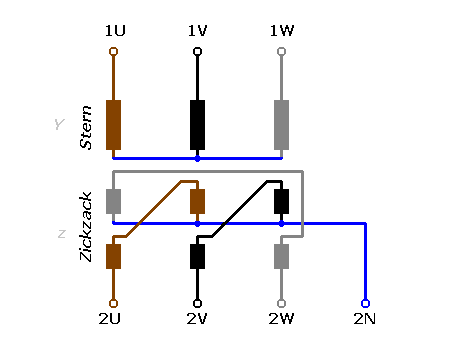
6. Zigzag transformer

A zigzag transformer is a special purpose transformer. It has primary windings but no secondary winding. Its applications are for the creation of a missing neutral connection from an ungrounded 3-phase system to permit the grounding of that neutral to an earth reference point and also harmonic mitigation, as it can suppress triplet (3rd, 9th, 15th, 21st, etc.) harmonic currents, to supply 3-phase power as an autotransformer (serving as the primary and secondary with no isolated circuits)  and to supply non-standard, phase-shifted, 3-phase power.


Figure: Zigzag transformer

Applications: 

  • One application is to derive an earth reference point for an ungrounded electrical system. 
  • Another is to control harmonic currents.

7. Pulse transformers

A pulse transformer is a transformer that is optimized for transmitting rectangular electrical pulses (that is, pulses with fast rise and fall times and constant amplitude). 


Figure: Bothhand TS6121A pulse transformer

Applications:

  • Small versions called signal types are used in digital logic and telecommunications circuits, often for matching logic drivers to transmission lines. 
  • Medium-sized power versions are used in power-control circuits such as camera flash controllers. 
  • Larger power versions are used in the electrical power distribution industry to interface low-voltage control circuitry to the high-voltage gates of power semiconductors. 
  • Special high voltage pulse transformers are also used to generate high power pulses for radar, particle accelerators, or other high energy pulsed power applications.

8. Audio transformer

Audio transformers or Audio Frequency (AF) Transformers are those specifically designed for use in audio circuits to carry audio signal. They can be used to block radio frequency interference or the DC component of an audio signal, to split or combine audio signals, or to provide impedance matching between high and low impedance circuits, such as between a high impedance tube (valve) amplifier output and a low impedance loudspeaker, or between a high impedance instrument output and the low impedance input of a mixing console. Audio transformers that operate with loudspeaker voltages and current are larger than those that operate at microphone or line level, which carry much less power.


Figure: Audio Frequency (AF) Transformers

Application: 

  • Audio transformers are used in car radios and broadcast equipment, and in sound reinforcement applications to steps up the output of the system's amplifier.


9. Isolation transformers 

An isolation transformer is a device that transfers energy from the alternating current (AC) supply to an electrical or electronic load.  It isolates the windings to prevent transmitting certain types of harmonics. 


Figure: A 230V isolation transformer.

Applications: 

  • It is used as a power supply for medical equipment, when it is necessary to prevent any leakage from the AC power system into devices connected to a patient.
  • Some small transformers are used for isolation in pulse circuits.
  • In electronics testing and servicing an isolation transformer is a 1:1 (under load) power transformer used for safety.
  • Supplying power to ships.

10. Buck boost transformers

A Buck boost transformer is a type of transformer used to make adjustments to the voltage applied to alternating current equipment. Buck boost transformers make small adjustments to the incoming voltage. One major advantages of Buck boost transformers are their low cost, compact size and light weight. 
Figure: Typical multi-tap buck–boost transformer.

Applications:

  • Buck boost transformers can be used to power low voltage circuits including control, lighting circuits, or applications that require 12, 16, 24, 32 or 48 volts, consistent with the design's secondaries.
  • They are often used to change voltage from 208v to 240v for lighting applications. 

11. Pad mounted transformers 

A padmount or pad-mounted transformer is a ground mounted electric power distribution transformer in a locked steel cabinet mounted on a concrete pad. Since all energized connection points are securely enclosed in a grounded metal housing, a padmount transformer can be installed in places that do not have room for a fenced enclosure. Padmount transformers are used with underground electric power distribution lines at service drops, to step down the primary voltage on the line to the lower secondary voltage supplied to utility customers. A single transformer may serve one large building, or many homes. Pad Mounted Transformers are usually single phase or three phase and is used where safety is a main concern.


Figure: Large pad-mount transformers supplying power to a computer data center. No live wires are exposed.

Applications:

  • Typical Application is restaurant, commercial building, shopping mall, institutional. 


12. Pole mounted transformers 

Outside a typical house one can see one of these devices mounted on the top of an electrical pole.
Figure: Pole mounted distribution transformer.

Applications:

  • Pole Mounted Transformers are used for distribution in areas with overhead primary lines. 


13. Oil filled transformers 

Oil-filled transformers are transformers that use insulating oil as insulating materials.  The oil helps cool the transformer. Because it also provides part of the electrical insulation between internal live parts, transformer oil must remain stable at high temperatures over an extended period.

Applications: 

  • Oil filled transformers are used in power distribution or electrical substations.


14. Rotary transformers

A rotary (rotatory) transformer is a specialized transformer used to couple electrical signals between two parts that rotate in relation to each other. They may be either cylindrical or 'pancake' shaped.


Figure: Cross-section diagram of a simple rotary transformer.

Applications: 

  • Rotary transformers are most commonly used in videocassette recorders. 
  • Another use is to transmit the signals from rotary torque sensors installed on electric motors, to allow electronic control of motor speed and torque using feedback.

15. Dry type transformers 

Dry type transformers require minimum maintenance to provide many years of reliable trouble free service. Unlike liquid fill transformers which are cooled with oil or fire resistant liquid dielectric, dry type units utilize only environmentally safe, CSA and UL recognized high temperature insulation systems. Dry type transformers provide a safe and reliable power source which does not require fire proof vaults, catch basins or the venting of toxic gasses. These important safety factors allow the installation of dry type transformers inside buildings close to the load, which improves overall system regulation and reduces costly secondary line losses. 

Dry type transformers are a rather mature product and technology, but of all the components in a power system, a transformer replacement can be a physically challenging event, extended delivery of a replacement or repair unit and expensive transportation costs. These are transformers whose core and coils are not immersed in insulating oil. 

“Dry type” simply means it is cooled by normal air ventilation. The dry type transformer does not require a liquid such as oil or silicone or any other liquid to cool the electrical core and coils. 

Applications:

  • Fire-resistant dry type or "cast resin" transformers are well suited for installation in high rise buildings, hospitals, underground tunnels, school, steel factories, chemical plants and places where fire safety is a great concern. Hazard free to the environment, dry type transformers have over the years proven to be highly reliable. 

Download this Article as PDF:
 Different Types Of Transformers And Their Applications

Related Posts Plugin for WordPress, Blogger...